Thought for the day:

"Give me grace to amend my life, and to have an eye to mine end, without grudge of death, which to them that die in thee,
good Lord, is the gate of a wealthy life."
St. Thomas More

THREE THINGS

"Three things are necessary for the salvation of man; to know what he ought to believe; to know what he ought to desire; and to know what he ought to do."
St. Thomas Aquinas

Rights of Man?

"The people have heard quite enough about what are called the 'rights of man'. Let them hear about the rights of God for once". Pope Leo XIII Tamesti future, Encyclical

Eternity

All souls owe their eternity to Jesus Christ. Unfortunately, many have turned their back to him.


Sunday, September 9, 2018

St. Peter Claver


Saint Peter Claver, Confessor
 

Peter Claver was a Spanish Jesuit. In Majorca he fell in with the holy lay-brother Alphonsus Rodriguez, who, having already learned by revelation the saintly career of Peter, became his spiritual guide, foretold to him the labours he would undergo in the Indies, and the throne he would gain in heaven. Ordained priest in New Granada, Peter was sent to Cartagena, the great slave-mart of the West Indies; and there he consecrated himself by vow to the salvation of those ignorant and miserable creatures. For more than forty years he laboured in this work. He called himself 'the slave of the slaves.' He was their apostle, father, physician, and friend. He fed them, nursed them with the utmost tenderness in their loathsome diseases, often applying his own lips to their hideous sores. His cloak, which was the constant covering of the naked, though soiled with their filthy ulcers, sent forth a miraculous perfume. His rest after his great labours was in nights of penance and prayer. However spent he might be, when news arrived of a fresh slave-ship, Blessed Peter immediately revived, his eyes brightened, and he was at once on board amongst his dear slaves, bringing them comfort for body and soul. A false charge of reiterating baptism for a while stopped his work. He submitted without a murmur till the calumny was refuted, and then God so blessed his toil that 40,000 negroes were baptized before he went to his reward in 1654.


Saint Peter Claver’s Story

A native of Spain, young Jesuit Peter Claver left his homeland forever in 1610 to be a missionary in the colonies of the New World. He sailed into Cartagena, a rich port city washed by the Caribbean. He was ordained there in 1615.

By this time the slave trade had been established in the Americas for nearly 100 years, and Cartagena was a chief center for it. Ten thousand slaves poured into the port each year after crossing the Atlantic from West Africa under conditions so foul and inhuman that an estimated one-third of the passengers died in transit. Although the practice of slave-trading was condemned by Pope Paul III and later labeled “supreme villainy” by Pope Pius IX, it continued to flourish.
Peter Claver’s predecessor, Jesuit Father Alfonso de Sandoval, had devoted himself to the service of the slaves for 40 years before Claver arrived to continue his work, declaring himself “the slave of the Negroes forever.”

As soon as a slave ship entered the port, Peter Claver moved into its infested hold to minister to the ill-treated and exhausted passengers. After the slaves were herded out of the ship like chained animals and shut up in nearby yards to be gazed at by the crowds, Claver plunged in among them with medicines, food, bread, brandy, lemons, and tobacco. With the help of interpreters he gave basic instructions and assured his brothers and sisters of their human dignity and God’s love. During the 40 years of his ministry, Claver instructed and baptized an estimated 300,000 slaves.

Fr. Claver’s apostolate extended beyond his care for slaves. He became a moral force, indeed, the apostle of Cartagena. He preached in the city square, gave missions to sailors and traders as well as country missions, during which he avoided, when possible, the hospitality of the planters and owners and lodged in the slave quarters instead.

After four years of sickness, which forced the saint to remain inactive and largely neglected, he Claver on September 8, 1654. The city magistrates, who had previously frowned at his solicitude for the black outcasts, ordered that he should be buried at public expense and with great pomp.

Peter Claver was canonized in 1888, and Pope Leo XIII declared him the worldwide patron of missionary work among black slaves.


Charity to our Neighbor
 
When you see any one standing in need of your assistance, either for body or soul, do not ask yourself why someone else did not help him, but think to yourself that you have found a treasure. 'Do thou seek nothing in this world save that which Jesus Christ Himself has sought--to sanctify souls, to work, to suffer, nay, to die for their salvation.'--Blessed Peter Claver.

When Easter came, Blessed Peter left the town to search the mountains for the negroes who might be scattered among them. The tropical storms drenched him to the skin, but he never turned nor stopped. When he found a settlement he would never leave it till the last negro was brought to the Sacrament of Penance. He once suddenly left the house where he was staying, and plunged without guide or road into impracticable mountain recesses. None knew whither or why he went; but when he returned pale and worn, it was discovered that he had gone to administer the last Sacraments to three old negroes who had been abandoned by all the world, and had crawled into a ruined hut to die.
'Who is weak, and I am not weak? Who is scandalized,
and I am not on fire?'--2 Cor. xi. 29


Excerpts from the life of St. Peter Claver, S.J.:
the apostle of the Negroes, 1893


Administering Baptism
 
When Peter Claver thought them (the slaves) sufficiently instructed, he appointed a day for the administration of baptism. He arranged them in tens, giving the same name to each ten that they might better remember it. He baptized the children first, then the men and boys, and lastly the women and girls. But before beginning the ceremony, he knelt down and prayed fervently for those poor souls redeemed by the blood of God, to whom he presented them all, conjuring Him to purify them. This being done he arose, his face inflamed like a seraph's, and approached those to be baptized, accompanied by an interpreter and a Christian Negro and Negress, to act as god-father and god-mother. The neophyte knelt down with his hands joined upon his breast, and the father showing him the baptismal water in a silver vase, said, "Behold this saving water, which in virtue of the merits of Jesus Christ, washes and purifies the soul, rendering it brilliant as the sun. Behold the fountain of grace which makes men, children of God, and gives them a right to the kingdom of His glory. To obtain this favor we must repent of our sins, renounce the devil and the maxims of the world. Will you not do this with all your heart? Do you believe in Jesus Christ? Will you enter His Church and receive baptism?"

He repeated these words two or three times; and when the Negro had answered properly, he was immediately baptized. After this, in order to distinguish him from those not baptized, he put round his neck a medal bearing the names of Jesus and Mary. "Whilst thus employed, were he informed that any one of the sick was in danger, he hastened immediately to him. It is impossible to say how many souls he snatched from the devil by this prompt and timely succor; for many died instantly after baptism. On such occasions he immediately knelt down to thank God for deigning to employ him in the salvation of those unfortunates who without this grace would have been irretrievably lost.

When the ceremony of baptism was over, he made a pathetic exhortation to the newly-baptized, reminding them of the great benefit they had just received, and of the obligations they had contracted. He then exhorted them to observe faithfully the law of Jesus Christ, whose members they had become, and to die rather than violate it by a single sin; adding, that if unfortunately they should sin, they would find a salutary remedy, a secure and ever-open resource, in contrition and confession. After this he explained to them the way in which Christians should receive the sacrament of penance. To strike them the more forcibly, to give them a greater horror of sin, and to incite them more efficaciously to the practice of virtue, he drew a picture to them, on the one hand, of a lost soul, with the eternal punishments which God has prepared for sinners, and on the other a beautified soul, resplendent in glory; "Behold," he would say to them, "what you will one day be, if you are faithful in preserving the grace of baptism."

All these exercises finished with a fervent act of contrition and love of God. Taking the crucifix which he wore upon his breast, he held it up so that all might see it, and exclaimed, "Behold how our sins have treated our great God and loving Father. See to what a plight He is reduced by our exceeding malice and His boundless love for us! Yes, it is for us that He died upon this cross;--for us that He was plunged in this abyss of ignominy and suffering!" These words were accompanied with such deep sighs and bitter tears, that the poor savages replied with sobs and cries that would have moved the hardest hearts. Finding them in the dispositions he wished, he taught them to say and repeat often these beautiful words: "O Jesus Christ, only Son of God, Thou art my Father, my Mother, my Treasure, my only Good! I love Thee with all my heart, and I am grieved beyond measure that I have offended Thee: yes, I love Thee with all my strength and with all my soul." Then, at length, looking upon them as true children of God, purified in the blood of the Lamb, he tenderly embraced them all.

He showed a heart so affectionate, and a countenance so loving and full of joy, that these poor slaves, delighted with his goodness, and animated by that new spirit which baptism gives, knew not what return to make for so much love. In order to show their consolation and joy, they raised their eyes to heaven, clapped their hands, and threw themselves on their knees at his feet, that they might kiss at least the border of his cassock. Each one uttered redoubled shouts of gladness, and in his own language and manner overwhelmed the father with a thousand blessings. Wherever they met him afterward, they always showed the same demonstrations of love and respect, and prostrating themselves on the ground called him their master, their protector, their father; never thinking that they did enough to express their gratitude. This labor alone would have sufficed to occupy several missioners; yet to Father Claver it was not the labor of every year, but of every week, and almost of everyday. At the arrival of each fresh cargo of Negroes he was obliged to recommence the same exercises, with the same care and renewed trouble; so that he often had but short intervals to devote to other labors.


The Opinion of Peter Claver's Sanctity
 
Such in general were the heroic virtues of which Father Claver was an example to Carthagena, during nearly forty years. By these means, in spite of all the contradictions and persecutions to which he was always exposed, he ultimately subdued the most envenomed hatred, and compelled the most abandoned licentiousness to respect him. These were the causes of his prodigious successes, and acquired for him the title of the Apostle of the West Indies. They enabled him to change a corrupt city into one of sanctity, where for some time the piety of the primitive Christians again nourished. By these he effected so many conversions and prodigies, that the whole country resounded with his praises. The opinion and esteem of his sanctity became so great and universal, that all orders, ranks, and ages, eagerly sought to testify their veneration, confidence, and tenderness for him. The bishops and grand vicars of Carthagena, when granting him the necessary powers for his apostolic functions, took pleasure in confiding their flocks to him. Prelates, who from time to time visited Carthagena, never failed to visit him and to beg his prayers for those souls of which they had charge. Generals of the army, officers of the navy, and all the most distinguished personages, visited him on their arrival. They undertook nothing of importance without asking his prayers, nor did they depart without bidding him farewell, and asking his blessing for a prosperous journey.

The governor of the town together with the nobility often came to recommend to his prayers the preservation of Carthagena and its inhabitants. Prelates and priests made it their duty to consult him in the most difficult cases of conscience, and received his decisions as oracles. Religious addressed themselves to him as to a model of the most accomplished virtue and perfection. Merchants would not embark without receiving his blessing, and on their return their first inquiry was after him. In a word, persons of every rank and condition had such a high opinion of his power with God and of the rectitude of his views, that they seldom undertook any important enterprise without asking the assistance of his prayers and advice. People ran to meet him, falling at his feet, and kissing his hands, nor would they leave him till they had obtained his blessing. Almighty God made use even of the innocent mouths of children to bear witness to the virtues of His servant. If they met him in the street, they crowded round him on their knees, kissing his hands, and saying, "Holy Father Claver, recommend us to God." A report had spread through the Indies, and especially at Lima, that God had revealed to a very holy person His determination of destroying Carthagena had it not been for the merits and prayers of its apostle. For several years after this, children might be heard singing in the streets, " For Claver's sake God has spared Carthagena."

The best testimony of sanctity is the evidence of the people with whom a man lives, for they are beyond suspicion, and they are usually the most difficult to satisfy. The most minute actions and slightest defects are observed. But the long residence of Father Claver in the college of Carthagena only served to confirm and augment the highest opinion of his sanctity. If to try the patience of His servant, God sometimes permitted him to experience the censures and contradictions of his own brethren, there was not one of them who did not soon regret the little persecutions they had made him suffer. Whilst they seemed to forget the respect due to him, the reverential sentiments of their heart completely contradicted the indiscreet expressions of their lips. His superiors frequently spoke of the wonders of his sanctity, and the praise and eagerness with which they wished to enlist his prayers caused infinite pain to his humility. They gave a very convincing proof of their estimate of his sanctity during a severe illness he had twenty years before his death. It was necessary to bleed him. The blood was carefully collected, and all the fathers of the house procured some drops on linen, which they kept with great respect.

To all these testimonies, so honorable to the memory of this apostle, may be added that of Don Pedro de Zapata, who had been twice governor of the whole province of Carthagena. In the juridical informations which he caused to be taken soon after the father's death, he attests, "So great and so universally diffused was the reputation of Father Claver's sanctity, that he was considered the column and support of the state. In a city where the Jesuits have had many enemies, never had anyone been found to speak ill of him. It was impossible for him to recollect all the virtues and heroic actions of which he himself had been the witness, nor all the miracles performed through his intercession ; but that all which he had seen and heard of him, equaled whatever is related of those who are recognized and honored as saints by the Catholic Church.


Canonization
 
After this brief narrative of the heroic life of St. Peter Claver, we deem it proper to conclude with a short account of the two great miracles which caused the Sacred Congregation of Rites on Nov. 1st, 1887, to canonize the Apostle of the Negroes. It is a pleasure to notice that both miracles, as well as those approved by Pius IX, on the 17th of Aug., 1848, happened in America. It seems that God was pleased to glorify his servant in an especial manner in that land in which he had so long labored for the propagation of the faith.

Barbara Dressen, who was the subject of the first miracle, was born at Treves in 1779. She emigrated to the United States, and after the death of her husband, lived at Milwaukee. At the age of seventy a small wart appeared on her right cheek. At first she considered it a trifle, but soon it began to increase and to assume a reddish color. She then consulted Doctor Bayer who at once pronounced it an incurable cancer which would inevitably cause her death. The unfortunate woman knowing that the doctor was a man of deep learning, lost all hope of recovery from natural means and placed her trust in heaven alone.

Father Weninger of the Society of Jesus, was at that time giving a mission in Milwaukee. He was propagating the devotion to the Blessed Peter Claver, chiefly by applying the relics to the bodies of the sick. Barbara came to him and requested him to apply the relics to her malady. She faithfully recited the prayers which he had enjoined on her, and during two or three years she noticed that the disease gradually disappeared, so that there was every hope of a complete cure.

But God, with a view of glorifying his servant, intended for her a still greater trial. Unexpectedly the evil returned, the wart changed into an ulcer, and the flow created successive scabs of an itching and most excruciating nature. For ten years she endured the most intense suffering, yet never did she omit for a single day her prayers to the Blessed Peter Claver. Her faith was soon to receive its reward. Father Weninger after ten years' absence, returned to Milwaukee, and one of his first visitors was Barbara. Feeling an increase of faith, she hastened to him, and told him the history of her ten years' martyrdom. "I see," said she, "the Saint alone can help--can relieve me." She then knelt and begged to be again blessed with the relics of Blessed Peter Claver. Father Weninger, moved with compassion, applied the relics, first to the diseased cheek, then to the forehead, and finally to the left cheek. All pain instantly ceased. Her joy was intense,--thanking the priest she hastened from the house. On reaching the open air, she found that she had been cured,--the wind did not as formerly irritate her cheek--small scales as fine dust, fell from her face, and before she had arrived home, all traces of the evil had disappeared. Those who had known her, were struck with amazement, and sealed their testimony by an oath. She was eighty-two years of age, when thus marvellously cured, June 29th, 1861. Five years afterward, the commission sent to interrogate her upon the miracle, was forced to acknowledge that the evil so miraculously expelled, had never reappeared.

The second miracle took place in St. Louis. In 1853 Ignatius Strecker had brought his family from Germany to the United States, and in 1861 he was working at St. Louis in a soap factory. One day he happened to strike his breast against an angular piece of iron. The shock was very violent, and although no exterior injury was apparent, the breastbone had been bruised. He suffered acute pains followed by a burning sensation and a swelling of the wounded part. And yet it was only after two years that he resolved to consult a physician. A large tumor had grown on the breast. He called in Doctor Heitzig, who immediately said that the bone was ulcerated. He had exhausted nearly all the resources of his medical skill, and at last after nine months he was forced to hold a consultation with his partner, Dr. Schoeneman. They did all in their power to check the ulceration which, by this time, had spread to three ribs of the left side. All remedies proved ineffectual to stop the progress of the evil, but rather complicated the maladies,--asthma, fever, a cough, suffocation, night sweats attacked the man in turns. He was so reduced that his skin was almost transparent. For two years had he endured all these sufferings, without one interval of rest. The doctors finally pronounced his case hopeless, and told him that he could not live beyond the 15th day. He then absolutely renounced all treatment and dismissed his physician.

His wife had heard Father Weninger preach upon the efficacy of recourse to Blessed Peter Claver, and she induced Strecker to have recourse to him. He went with great difficulty to the church where Father Weninger was applying the relics to a large number of sick. He was touched and blessed with the relics and his strong faith was soon rewarded. From that moment, the tumor ceased to flow, an indication that the ulceration had come to an end. In a few weeks, the wound healed, and all the accompanying evils, as well as the advanced symptoms of consumption, disappeared, so that shortly after his visit to the church, he had recovered his former vigor. He justly acknowledged that he owed this great favor to the intercession and merits of Blessed Peter Claver, whom God had wished once more to glorify. Dr. Schoeneman, who had despaired of his recovery, was greatly surprised at this unexpected cure ; and although not a Catholic, he regarded the fact as a manifestation of God's omnipotence.

On the canonical verification of these two miracles, the Sacred Congregation of Rites proclaimed on the 26th day of November, 1887, that the canonization of Blessed Peter Claver might be undertaken; and on the 15th of January, 1888, Leo XIII placed St. Claver upon the altar, together with his holy friend, Alonzo Rodriguez--thus uniting in glory those whom God had so intimately united here below.


O God, Who in order that wretched slaves might come to the knowledge of Thy Name, didst endow St. Peter Claver, Thy confessor, with wonderful self-denial and eminent charity: grant that, by virtue of his example, many souls may be inspired with compassion for the poor Negroes and may courageously devote themselves to their conversion. Through Jesus Christ Our Lord. Amen
 
St. Peter Claver: Pray for us,
O God, Who calling to the knowledge of Thy Name the Negro tribes sold into slavery, didst, in order that he might be a help to them, imbue blessed Peter with marvelous patience and charity: giving ear to his prayers, vouchsafe unto us to seek only the things which are of Jesus Christ, and thereby to love our neighbor in deed and in truth. Through the same Christ our Lord, Who with Thee and the Holy Ghost liveth and reigneth, one God, world without end. R. Amen.


Saturday, September 8, 2018

HAPPY BIRTHDAY BLESSED MOTHER!

'O Virgin, Mother of God, Thy birth has announced joy to the whole world, for from Thee has proceeded the Sun of justice, Christ our Lord, Who, by taking away the curse, has shed benediction and Who, by confounding death, has given us everlasting life.'  Antiphon to the Magnificat for today's Mass.


We, who still cling to the pre-Vatican II calendar, have yet another great Feast day! The birth of our Blessed Mother Mary. She had been immaculately conceived in her mother Anne's womb, thus making her the purest of the pure. She is the one who is to crush the old serpent's head with her heel, and will lead us to her Son. She is the only one to say "Yes" of 'fiat', when told that she would be the mother of 'THE ONE' who is to come. She, who is our only hope, will bring us to eternal happiness. She, who has, and will continue, to crush all heresies, will come to our aid; if we ask. She, who was made the mother of us all, (through John, who stood in our place), while Jesus was on the Cross, will guide us to all Truth as she did the Apostles and disciples after Pentecost.

I put it to protestants this way; in a way maybe they can understand. A simple math solution: If A=B, and B=C; then A=C. Right? Now, if Jesus is God; and Mary is the mother of Jesus; she must be the Mother of God. See how easy this is? I also would ask them if they would take offense if I were to call their mother names or told lies about her, even though I had never met her? When they would reply that they definitely get mad, I would tell them: 'So does Jesus. He will remember all the times you were hateful towards His mother. If you can't say anything decent about her, SHUT UP!'

As the Jewish nation had the 'Ark of the Covenant', which held the Truth as they saw it, so now we have Mary as the 'ARK of the New Covenant', carrying Jesus Himself! She IS the tabernacle which held and still holds the True Manna for our souls.

Now, let's find out about Mary herself.


The NATIVITY
of the BLESSED VIRGIN
(ca. 15 B.C.)


The birth of the Blessed Virgin Mary announced joy and the approaching salvation of a lost world. Mary was brought into the world not like other children of Adam, infected with the contagion of sin, but pure, holy, beautiful, and glorious, adorned with all the most precious graces fitting for the One predestined to be the Mother of the Saviour. Never did She have the slightest inclination towards anything other than the absolute and immediate Will of God. She appeared indeed in the weak condition of all mortals, but in the eyes of Heaven She already transcended the highest Seraphim in purity, humility, charity, and the richest ornaments of grace. God had created Her in the original grace, as in the beginning Adam and Eve had enjoyed that ineffable privilege; after original sin, it was lost for all Adam's posterity, until the time of the Redemption dawned in Mary. (Cf. I Cor. 15:21-23)

The nations celebrate, often too noisily, the birthdays of the great ones of this earth... How then ought we, Christians, to rejoice in that of the Virgin Mary, Mother of our Salvation, and to present publicly to God the homage of our best praises and thanksgiving for the great mercies He has shown in Her, imploring Her mediation with Her Divine Son! Jesus of Nazareth will not reject the supplications of His most holy Mother, through whom He chose to descend from Heaven; She, the Spouse of the Canticle, is all beautiful and is the One He was pleased to obey while on earth. Her love, care, and tenderness for Him, the title and qualities which She bears, the charity and graces with which She is adorned, and the crown of glory with which She is honored, incline Him readily to receive Her recommendations and petitions.

The Angelical Salutation is the prayer which most pleases Mary; but when time is short we can invoke Her constantly by short ejaculatory prayers, such as the one She entrusted to Ste. Catherine Labouré in 1830 with the Miraculous Medal: 'O Mary conceived without sin, pray for us who have recourse to Thee!' or, shorter yet: 'My Mother, my confidence!'Or, even: 'Jesus, Mary, Joseph, I love thee, save souls.' The prayer for today's Mass: 'Bestow upon Thy servants, we beseech Thee, O Lord, the gift of Thy heavenly grace, that, as the childbearing of the Blessed Virgin was the beginning of our salvation, so the votive feast of her Nativity may bring us an increase of peace.'


This is a day of universal happiness, since through the birth of Our Blessed Mother the sorrow of our first mother, Eve, was transformed into joy.


September 8 marks the Feast of the Nativity of the Blessed Virgin Mary. This day of celebration, which is thought to have first originated in Syria or Palestine, was brought to the Church of Rome sometime in the seventh century. Although it would take several more centuries before all of Western Christendom honored Our Lady’s birth liturgically, during the reign of Pope Innocent IV in 1243, the feast was adorned with an octave and celebrated with great solemnity.


Consider the following reflection on the life of the Blessed Virgin by St. Augustine which constitutes the readings for the Second Nocturn of Matins for this feast.


"Dearly beloved brethren, the day for which we have longed, the Feast-day of the Blessed and Worshipful and Ever-Virgin Mary, that day is come. Let our land laugh and sing with merriment, bathed in the glory of this great Virgin's rising. She is the flower of the fields on which the priceless lily of the valleys hath blossomed. This is she whose delivery changed the nature that we draw from our first parents, and cleansed away their offence. At her that dolorous sentence which was pronounced over Eve ended its course to her it was never said: 'In sorrow thou shalt bring forth children.' Gen. iii. 16. She brought forth a Child, even the Lord, but she brought Him forth, not in sorrow, but in joy.

"Eve wept, but Mary laughed. Eve's womb was big with tears, but Mary's womb was big with gladness. Eve gave birth to a sinner, but Mary gave birth to the sinless One. The mother of our race brought punishment into the world, but the Mother of our Lord brought salvation into the world. Eve was the foundress of sin, but Mary was the foundress of righteousness. Eve welcomed death, but Mary helped in life. Eve smote, but Mary healed. For Eve's disobedience, Mary offered obedience and for Eve's unbelief, Mary offered faith.


"Let Mary now make a loud noise upon the organ, and between its quick notes let the rattling of the Mother's timbrel be heard. Let the gladsome choirs sing with her, and their sweet hymns mingle with the changing music. Hearken to what a song her timbrel will make accompaniment. She saith: 'My soul doth magnify the Lord, and my spirit hath rejoiced in God my Saviour. For He hath regarded the lowliness of His hand-maiden, for, behold, from henceforth all generations shall call me blessed for He That is Mighty hath done to me great things.' The new miracle of Mary's delivery hath effaced the curse of the frail backslider, and the singing of Mary hath silenced the wailing of Eve."
For Greek Catholics, the Feast of the Nativity of the Blessed Virgin Mary is considered one of the 12 principal feasts of the liturgical year, though its octave is abbreviated due to the Feast of the Exaltation of the Holy Cross on September 14. The service of Matins for the Byzantine Rite is mainly comprised of hymns penned by Ss. John of Damascus and Andrew of Crete which recount both the Virgin’s miraculous birth from her barren mother, St. Anna, and how Mary’s Nativity foreshadows the coming of Our Lord Jesus Christ. Here is a small sample:


Anna was barren and unable to give birth, yet she was not childless in God's eyes; for, lo she hath become known by all generations as the mother of the pure Virgin, from whom the Creator of nature hath sprung forth in the guise of a servant.

"Today is the bridge of life born, through which men have attained restoration after their fall into Hades, glorifying Christ, the Bestower of life, with hymns.

"From a barren woman did the Lord, Who poureth forth life upon all, cause the Virgin to come forth, in whom He was pleased to make His abode, preserving her incorrupt even after giving birth.
"The whole world rejoiceth with thee today, O divinely wise Anna; for thou hast budded forth the Mother of its Deliverer, she who from the root of David put forth for us the rod of strength which beareth Christ as a flower."


The Angels' Birthday Song to Mary.

"Thy nativity, O Virgin Mother of God, gives joy to the whole world, because from thee shall rise the Sun of Justice, Christ our Lord."--The Church. Cant. iii. 6: "Who is she that goeth up by the desert, as a pillar of smoke of aromatical spices, of myrrh and frankincense? "


Hail to the Flower of grace divine!
Heiress, hail of David's line!
Hail Redemption's heroine!
Hail to the Virgin pre-elect!
Hail to the work without defect
Of the supernal Architect!

Hail to her ordained of old
Deep in enmities untold,
Ere the blue waves of ocean rolled,
Ere the primordial founts had sprung,
Ere in ether the globe was hung,
Ere the morning stars had sung!

Welcome the beatific morn
When the mother of life was born,
Whom all lovely gifts adorn!
What a thrill of ecstatic mirth
Danced along through heaven and earth.
At the tidings of Mary's birth!

How was hell to its centre stirred!
How sang Hades when it heard
Of her coming, so long deferred!
Happy, happy, the angel band
Chosen by Mary's side to stand
As her defense on either hand!

Safe beneath their viewless wings
Mother-elect of the King of kings,
Fear no harm from hurtful things!
What though Eden vanished be,
More than Eden we find in thee!
Thou our joy and jubilee!


Let us go to her, and be quick about it!

Friday, September 7, 2018

1st Friday


The Sacred Heart of Jesus appeared to St. Margaret Mary Alacoque at Paray-le-Monial in France, during 1674.  Whilst in this Apparition, He spoke in detail of His wishes for the Holy Hour   First Friday Devotion  "The First Friday of each month was designated by our Savior Himself as a day to be consecrated to honoring His Sacred Heart…. As the object of this devotion is to make our Savior Jesus Christ ardently and perfectly loved, and to make reparation for the outrages offered to Him in the past, as well as for those which he daily receives in the Blessed Eucharist…Jesus Christ merits our love at all times, but alas! He is despised and outraged in the Sacrament of His love at all times, and so people should at all times make reparation to Him. We should then adore Jesus Christ in this august Sacrament, make a fervent act of love to Jesus in the tabernacle, thank Him for having instituted this Mystery of love, express our sorrow at seeing Him so abandoned, and resolve to visit Him as soon as possible and love Him unceasingly. Attendance at the Holy Sacrifice of the Mass is assuredly the best means of honoring and loving the adorable Heart of Jesus.


The following First Friday devotions are efficacious in honoring the Sacred Heart of Jesus: 

1. The Holy Sacrifice of the Mass
2. Adoration of the Blessed Sacrament
3. Act of Consecration to the Sacred Heart of Jesus
4. Act of Reparation 
5. The Litany of the Sacred Heart of Jesus
6. The Sacrament of Reconciliation

The Promises of the Sacred Heart of Jesus to St. Margaret Mary Alacoque:

1. "I will give them all the graces necessary in their state of life." 
2. "I will establish peace in their homes." 
3. "I will comfort them in their afflictions."
4. "I will be their secure refuge during life, and above all in death." 
5. "I will bestow a large blessing upon all their undertakings." 
6. "Sinners shall find in My Heart the source and the infinite ocean of mercy." 
7. "Tepid souls shall grow fervent." 
8. "Fervent souls shall quickly mount to high perfection." 
9. "I will bless every place where a picture of My Heart shall be set up and honored." 
10. "I will give to priests the gift of touching the most hardened hearts." 
11. "Those who shall promote this devotion shall have their names written in My Heart, never to be blotted out." 
12. "I promise thee in the excessive mercy of My Heart that My all-powerful love will grant to all those who communicate on the First Friday in nine consecutive months, the grace of final penitence; they shall not die in My disgrace nor without receiving the Sacraments; My Divine heart shall be their safe refuge in this last moment."


In order to help us to understand more deeply the development of the First Friday Devotion let us look at the work of Father John Croiset, S.J.

It was he who became St. Margaret Mary’s confessor and Spiritual Advisor, following the death of St. Claude La Columbiere.  Like St. Claude, he dedicated his life to the spreading of the Devotion.
 
In fact, through a request received in a message to St. Margaret Mary, Our Lord asked that Father Croisset write a detailed manual on the new Devotion to the Sacred Heart of Jesus.
It is this book, The Devotion to the Sacred Heart, that we refer to here. Regarding the First Friday Devotion Father Croiset writes:

The object of this devotion is to make our Saviour Jesus Christ ardently and perfectly loved, and to make reparation for the outrages offered to Him in the past, as well as for those which He daily receives in the Blessed Eucharist.
 
 
OLYMPUS DIGITAL CAMERA
Sacred Heart window, Co. Tyrone, Ireland
 
Father Croiset also points out, as I have noticed through my years of practice of this Devotion, that many people begin preparation for the First Friday, on the Thursday preceding it.

On this first Thursday, the Holy Hour is more greatly emphasized and confession is often made, in order to worthily communicate on the First Friday – in a state of grace.

Thus, one may wish to seek out a suitable Priest, who practices the Devotion himself. Such a priest will likely offer a number of beautiful, devotional practices which have become associated with the First Friday over the last centuries.

These include: particular or special confession times prior to Holy Mass, Adoration of the Blessed Sacrament and Benediction, recitation of the Litany of the Sacred Heart. He may even celebrate a votive Mass for the Feast of the Sacred Heart each First Friday.  Others may  offer exposition throughout the night, into the First Saturday (dedicated to the Immaculate Heart of Mary).
Following Father Croiset’s direction,  it is important to spend the First Fridays (as also with the Feast of the Sacred Heart) contemplating the outrages and sacrileges, which have caused Our Lord so much distress.

Yet whilst the Sacred Heart revealed to St. Margaret Mary His suffering on account of our ingratitude, it is we who suffer most at being separated from Our Divine Lord. It is we who remain in sin, when we are not bathed in the Divine love, issuing forth from the Heart of Our Lord and Saviour.


Therefore, whilst Our Lord pleads with us to make amends, through Reparation to Him, we should remember that, whilst clearly pleasing Him, the effects of Communion and Reparation on the First Friday work to bring us back to Him.

They work to bring us back to the source of all life, to the Heart of God, present in the person of Jesus Christ: the Sacred Heart. They work to make amends that will bring us and our fellowmen, back into relationship with our means of salvation; Our loving Friend and God, Jesus Christ.
He is hurting because He has given us everything and we have not acknowledged this. We have in fact, turned our backs on Him. Yet He gave us everything, not for Himself, but for us.

Wednesday, September 5, 2018

St. Lawrence Justinian


The following concerning this saint is by
Prof. Plinio Corrêa de Oliveira


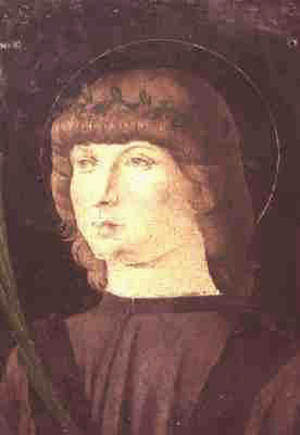
St. Laurence Justinian as a young man

St. Laurence Justinian as a young man by Bellini
Laurence was born into the illustrious Venetian family of the Justinians (Giustiniani), and while still a child, he was remarkable for the seriousness of his character. His piety produced admiration and respect.

At age 19 he had a vision of Eternal Wisdom inviting him to unite himself with it. He entered the religious life in the Augustinian Order of the Canons of St. George on Alga Island, one mile from Venice. He was noted for his great austerities and humiliations. He used to go beg alms for the community, and often received sarcastic barbs instead of goods, for which he thanked God.

Soon after his ordination he was elected General of his Order. He reformed it so profoundly that he is considered its second founder. In 1433 he was named Bishop of Venice. He tried to refuse the dignity, but Pope Eugene IV obliged him to accept it. He brought peace to numerous state quarrels, founded 15 new monasteries and added many new parishes in which he took a special care of the accuracy and beauty of the divine worship.

In 1450 he was elected Patriarch of Venice. The ecclesiastic reform he made in Venice is justly considered a precursor to what St. Charles Borromeo did in Milan after the Council of Trent. His books and sermons transmit a great devotion to the Passion of Our Lord. On January 8, 1455 he died. He was beatified in 1524 by Clement VII and canonized in 1690 by Alexander VIII. His feast day was established for September 5, the day of his episcopal consecration.

Comments of Prof. Plinio:

First, it is interesting to see that since his childhood St. Laurence Justinian was marked by a profound seriousness and that his piety produced admiration and respect. Anyone who saw him was impressed by his seriousness. This is the way it should be. According to the sentimental piety that infiltrated the Church in the 18th and 19th centuries, the saints should all be amiable, tender, and soft. St. Laurence was the opposite of such a model since his childhood. This is excellent! I don’t deny that piety at times can cause tenderness, but to hold it up as the principal note of sanctity seems absurd to me. According to the selection, his piety produced admiration and respect. These are the true characteristics of sanctity, as God always causes respect and admiration, and the saint is a man who lives with God.

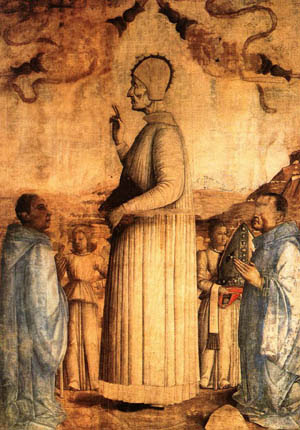
St. Laurence Justinian as Patriarch of Venice

St. Laurence Justinian as Patriarch of Venice
The sentimental way to describe the saints is one-sided and deforms the souls. Such sentimentalism should be avoided, and a good criteria to know when we have an objective description of the saint is to see if the portrayal produces admiration and respect.

Second, while he was very young, he entered an Order that was corrupted, putrid. He was elected its superior and reformed it to the point that he is considered its second founder. That is, it was an Order so rotten that it needed a general reform, and was reborn at the hands of a saint. But it was not so rotten that it would not elect a saint to reform it. Today, what Order elects a saint to reform it?

Third, in 1433, about 100 years before the explosion of Protestantism, the Church was already immersed in the great crisis of the Revolution. The humanist mentality was promoting pride and sensuality everywhere, and preparing the way for the acceptance of the bad ideas of Protestantism. Well, St. Laurence Justinian reformed his Order, and instead of being persecuted and despised, he was named Patriarch of Venice. Once again, you can see a difference between that phase of the Revolution and the point it has reached in our days.

In those times, there was a St. Laurence Justinian as Patriarch of Venice and a St. Charles Borromeo as Archbishop of Milan; today instead there was a Angelo Rocalli in Venice and a John Baptist Montini in Milan. The first two Saints lived their lives in preparation for, or as a consequence of, the Council of Trent. That is to say, they dedicated themselves to help the Church to resist Protestantism. The two progressivist Cardinals (who became Popes) prepared the Church for Vatican Council II, which opened her doors not only to Protestantism but also to all the heresies synthesized in Modernism. At the time of St. Laurence, many people were already revolutionary but they were at least aware of the corruption and chose saints to reform them. In our times, people have lost the notion of good and evil and can actually think that those progressivist Cardinals were good. There is an enormous moral difference between these two steps of the Revolution.

Let us pray to St. Laurence Justinian asking him to give us his seriousness in order to face the Revolution within the Church and to help us to restore her, as he did in his Order and in the Archdiocese of Venice.

Monday, September 3, 2018

LABOR DAY

History of Labor Day 

Labor Day, the first Monday in September, is a creation of the labor movement and is dedicated to the social and economic achievements of American workers. It constitutes a yearly national tribute to the contributions workers have made to the strength, prosperity, and well-being of our country.

Labor Day Legislation
Through the years the nation gave increasing emphasis to Labor Day. The first governmental recognition came through municipal ordinances passed during 1885 and 1886. From these, a movement developed to secure state legislation. The first state bill was introduced into the New York legislature, but the first to become law was passed by Oregon on February 21, 1887. During the year four more states — Colorado, Massachusetts, New Jersey, and New York — created the Labor Day holiday by legislative enactment. By the end of the decade Connecticut, Nebraska, and Pennsylvania had followed suit. By 1894, 23 other states had adopted the holiday in honor of workers, and on June 28 of that year, Congress passed an act making the first Monday in September of each year a legal holiday in the District of Columbia and the territories.


The First Labor Day
The first Labor Day holiday was celebrated on Tuesday, September 5, 1882, in New York City, in accordance with the plans of the Central Labor Union. The Central Labor Union held its second Labor Day holiday just a year later, on September 5, 1883.

In 1884 the first Monday in September was selected as the holiday, as originally proposed, and the Central Labor Union urged similar organizations in other cities to follow the example of New York and celebrate a "workingmen's holiday" on that date. The idea spread with the growth of labor organizations, and in 1885 Labor Day was celebrated in many industrial centers of the country.


A Nationwide Holiday
The form that the observance and celebration of Labor Day should take was outlined in the first proposal of the holiday — a street parade to exhibit to the public "the strength and esprit de corps of the trade and labor organizations" of the community, followed by a festival for the recreation and amusement of the workers and their families. This became the pattern for the celebrations of Labor Day. Speeches by prominent men and women were introduced later, as more emphasis was placed upon the economic and civic significance of the holiday. Still later, by a resolution of the American Federation of Labor convention of 1909, the Sunday preceding Labor Day was adopted as Labor Sunday and dedicated to the spiritual and educational aspects of the labor movement.

The character of the Labor Day celebration has undergone a change in recent years, especially in large industrial centers where mass displays and huge parades have proved a problem. This change, however, is more a shift in emphasis and medium of expression. Labor Day addresses by leading union officials, industrialists, educators, clerics and government officials are given wide coverage in newspapers, radio, and television.

The vital force of labor added materially to the highest standard of living and the greatest production the world has ever known and has brought us closer to the realization of our traditional ideals of economic and political democracy. It is appropriate, therefore, that the nation pay tribute on Labor Day to the creator of so much of the nation's strength, freedom, and leadership — The American Worker.

Are Catholics to think warmly of Capitalism? Can wages be determined by business owners at will? Pope Leo XIII gave the answers 125 years ago:

Today is what Americans celebrate as Labor Day, when we honor all of those who labor, or have labored, in their quest for a better life. This doesn't include those who just have their hand out for something they haven't earned. There is so much more than this way of thinking. Let's ask a leader of the Holy Roman Catholic and Apostolic Church what he thinks.

With the civil holiday Labor Day , it would behoove Catholics to spend some time with Pope Leo XIII’s great social encyclical, Rerum Novarum. Published over 125 years ago, Rerum Novarum spells out the rights and duties of both capital and labor which, regrettably, are often ignored in the current economic order. Leo XIII, sensing the revolutionary changes which had torn apart the traditional economic order and left the working classes in a state of near-slavery, felt compelled to speak authoritatively on the matter despite the opinion of some that the Church has no business intervening in socio-economic affairs (paragraphs 2 and 3):


"Therefore, venerable brethren, as on former occasions when it seemed opportune to refute false teaching, We have addressed you in the interests of the Church and of the common weal, and have issued letters bearing on political power, human liberty, the Christian constitution of the State, and like matters, so have We thought it expedient now to speak on the condition of the working classes. It is a subject on which We have already touched more than once, incidentally. But in the present letter, the responsibility of the apostolic office urges Us to treat the question of set purpose and in detail, in order that no misapprehension may exist as to the principles which truth and justice dictate for its settlement. The discussion is not easy, nor is it void of danger. It is no easy matter to define the relative rights and mutual duties of the rich and of the poor, of capital and of labor. And the danger lies in this, that crafty agitators are intent on making use of these differences of opinion to pervert men's judgments and to stir up the people to revolt".


"In any case we clearly see, and on this there is general agreement, that some opportune remedy must be found quickly for the misery and wretchedness pressing so unjustly on the majority of the working class: for the ancient workingmen's guilds were abolished in the last century, and no other protective organization took their place. Public institutions and the laws set aside the ancient religion. Hence, by degrees it has come to pass that working men have been surrendered, isolated and helpless, to the hardheartedness of employers and the greed of unchecked competition. The mischief has been increased by rapacious usury, which, although more than once condemned by the Church, is nevertheless, under a different guise, but with like injustice, still practiced by covetous and grasping men. To this must be added that the hiring of labor and the conduct of trade are concentrated in the hands of comparatively few; so that a small number of very rich men have been able to lay upon the teeming masses of the laboring poor a yoke little better than that of slavery itself."


It is clear from these words, and the remaining paragraphs of Rerum Novarum, that the Church in no way, shape, or form wishes to endorse the revolutionary socialism which had rocked Europe throughout the 19th Century. At the same time, Leo XIII gives no sanctuary to unrestrained, free-market capitalism, the sort which is sometimes upheld by misguided Catholics enchanted by the tenets of libertarian ideology. For while economic liberals believe that it is “natural” and “just” that workers’ wages ought to be established by the marketplace, Rerum Novarum contains a different teaching.

In paragraph 34, Pope Leo XIII acknowledges the liberal conception that wages “are fixed by free consent; and therefore the employer when he pays what was agreed upon, has done his part is not called upon for anything further.” “This mode of reasoning,” according to the Pope, “is by no means convincing to a fair-minded man, for there are other important considerations which it leaves out of view altogether.” These considerations include, but are not necessarily limited to, a man deriving enough wages from his work to support himself and his family while also building-up enough savings to purchase his own property (paragraphs 44 and 45). Indeed, Leo XIII refers to this as “a dictate of natural justice,” that is, a principle which holds universally true across all times, places, and economic cultures. Although workers’ wages may vary according to the nature of their profession, experience, and other relevant factors, it is clear from Rerum Novarum that all in society must adhere to a just “base floor” for settings wages rather than market prices alone.

Elsewhere in Rerum Novarum, Leo XIII upholds the Church’s teaching on the right to private property and encourages greater cooperation between social classes. In other words, the text makes clear that the elimination of private property—one of the express aims of socialism—is not congruent with either divine or natural law. Further, Leo XIII, in his wisdom, does not wish for the Church’s magisterium to be leveraged by revolutionary forces. While it is true that grave economic injustices are to be found throughout the world, the aim of both the Church and civil society should be to see those wrongs rectified without reliance on express class conflict or violence.


Here are the Pope’s own words (paragraph 19):

"The great mistake made in regard to the matter now under consideration is to take up with the notion that class is naturally hostile to class, and that the wealthy and the working men are intended by nature to live in mutual conflict. So irrational and so false is this view that the direct contrary is the truth. Just as the symmetry of the human frame is the result of the suitable arrangement of the different parts of the body, so in a State is it ordained by nature that these two classes should dwell in harmony and agreement, so as to maintain the balance of the body politic. Each needs the other: capital cannot do without labor, nor labor without capital. Mutual agreement results in the beauty of good order, while perpetual conflict necessarily produces confusion and savage barbarity. Now, in preventing such strife as this, and in uprooting it, the efficacy of Christian institutions is marvelous and manifold. First of all, there is no intermediary more powerful than religion (whereof the Church is the interpreter and guardian) in drawing the rich and the working class together, by reminding each of its duties to the other, and especially of the obligations of justice."

Today, well more than a century after Rerum Novarum’s promulgation, we can see with great sorrow just how far away the world is from embracing Leo XIII’s teaching. Radical economic inequality coupled with dislocating shocks to the marketplace brought on by unchecked greed and material excess continue to leave millions of persons, even in America, under the thumb of usurious lending, depressed wages, and politicians seeking to harness economic discontent for their own worldly aims.


Although God has not promised man an “earthly paradise” where every social and economic ill can be cured, He has left us the Church and her magisterium to guide us on our pilgrimage to Heaven. It should come as no surprise then that the further society moves away from those teachings, particularly the social rights of Christ the King, the worse off it will become, not just materially, but morally and spiritually as well. Let us pray for the day when politicians, capitalists, and laborers draw closer to the teachings contained in Rerum Novarum and that the economic sphere is once again guided by the dictates of justice rather than the forces of avarice. (Thank you SSPX for this last part from Pope Leo XIII)


As a note: I know that ALL of the big corporations have sold their collective souls
for the quest of money, sending their business overseas for an example, to get cheaper hired help, even though this cheaper worker is not up to the standards that proud Americans stand for. I worked for an automotive giant for 30 years, and I can tell you this: After working on my feet, on cement, bending, twisting, and using machinery for 8-9+ hours each day, my body is a wreck. There is NO one working there who does not have some kind of problems with their backs, hips, knees, wrists, and so forth. NO ONE! And then, we retire, our benefits go down every year. So much for a thank you! These people who work for their pay are EARNING it, no matter what the 'socialistic' leaders and stupid people think. I'll ask this of you: Take one part of your job, whatever it is (even making a phone call), standing up, and doing it for at least 8 hours, and do it every 45 seconds. See if it doesn't get monotonous after awhile. This is what it is like. Be proud of the American worker! He/She is working hard trying to make a living for their family, and we should thank them each day.


Anyway:

Pope St. Pius X

Today we celebrate Pope St. Pius X, and, because of him, we have the Traditional Mass continuing.  This is due to him and Ecclesia Dei (the group of priests in the Chicago area who fought to have the Mass to be said in Latin after Msgr. Lefevre consecrated the Bishops, thus earning him the wrongly imposed excommunication).  These priests were also instrumental in preserving the Mass of Time Immoral in the U.S..  From Pius X we learn again that 'the folly of the Cross', simplicity of life, and humility of heart, are still the indispensable conditions of a perfect Christian life.

When most Catholics hear the name of Pope St. Pius X, they think of the great saint who pulverized modernism, that “synthesis of all heresies” in the early twentieth century. Many are also aware of his Eucharistic reforms, which promoted frequent communion and communion for young children. Some may also be aware of his conflict with the anti-clerical French State, which led to the Law of Separation and the subsequent material impoverishment of the French Church. Fewer are aware that Pius X, in his short eleven year reign, ranks as one of the greatest reforming popes in history. These reforms which he initiated were important, timely, and needed. Pius X contributed to reforms in papal elections, seminary life, Eucharistic practice, sacred music, biblical studies, the breviary, catechesis, the organization of the Roman Curia, and Canon Law. Many of these reforms arose from needs which he saw in his pastoral work as curate, pastor, canon, spiritual director at the seminary, diocesan chancellor, bishop, metropolitan, cardinal, and pope.


The Pastoral Career of Pope St. Pius X Giuseppe Melchiore, the oldest of eight surviving children, was born to Giambattista and Margherita Sarto on June 2, 1836 in Riese, a town lying in the Venetian plain. Giambattista was employed as a cursore, a minor village official in the Austrian administration, for Venetia was then under the political control of the Austrian Empire. In time, he was confirmed and then made his First Communion. While attending the College of Castelfranco, about seven kilometers from Riese, 'Beppi' displayed his academic excellence. In his eight examinations over the four years, Sarto always held the first place. Devoted to the Blessed Sacrament and the Virgin Mary, he also grew in piety. It came as no surprise that he was considering a priestly vocation.

The Sarto family was not in a position to finance Giuseppe’s seminary studies. Providentially, he was awarded a scholarship at the Seminary of Padua, one of the very best in all of Italy. While studying there he was especially drawn to the study of Scripture, the Fathers, scholastic philosophy, as well as sacred music. In time, he was ordained at Castelfranco on September 18, 1858 by the Bishop of Treviso, Msgr. Zinelli. As his first assignment, Don Giuseppe worked as curate in Tombolo, assisting the pastor, Don Antonio Constantini. Under the gentle hand of Don Antonio, Sarto learned how to preach in the plain and simple style which was so effective with the people, and which he would encourage his own priests to utilize later. After an apprenticeship of less than ten years, Don Giuseppe was named the pastor of Salzano in 1867. Here he instituted classes on Christian doctrine for both children and adults. At Salzano, he first formed a schola cantorum of men and boys at the church to sing Gregorian music.

Greatly pleased with the fine work of Don Sarto as a parish priest, Msgr. Zinelli, in April of 1875, called on the priest to take up more important duties in Treviso. He was not only appointed canon of the cathedral and chancellor of the diocese, but also spiritual director at the seminary. Seeing that the spiritual formation of Treviso’s future priests was his charge, he put heart and soul into this work. As the health of both the bishop and vicar general declined, the lion’s share of the diocesan administrative work devolved upon Sarto. In this way, he was initiated into running a diocese well before he was named bishop. In September of 1884 he received a letter appointing him Bishop of Mantua. He was genuinely disconcerted and did not think himself equal the task. Yet, he submitted. After a time of preparation, he traveled to Rome and was consecrated bishop on November 16.

Rome regarded Mantua as a serious trouble spot, where the state of the clergy was perilous. Mgsr. Sarto could not take possession of his diocese until April 1885, when he received the royal exequatur, the government’s authorization of his episcopal appointment. Early on, the young bishop focused his attentions on improving the spiritual life, the academic rigor, and the discipline in the seminary as the means of the future restoration of the clergy. As a means of rejuvenating the spiritual life of the Mantuans, he held two pastoral visitations and a diocesan synod. In May of 1893, on account of his fine management of a problematic diocese, Leo XIII appointed Mgsr. Sarto to the Patriarchate of Venice.

After Sarto arrived in Rome in early June, he met with Pope Leo XIII (he has to be another saint), who, in a secret consistory, created him cardinal and then publicly nominated him to the patriarchal see of Venice. Yet once again, Cardinal Sarto had to wait till November of 1894 to enter his see, for the exequatur arrived well over a year later. Finally, on November 24 the people of Venice provided their new patriarch with a grand welcome. Having pronounced, “There is too much preaching and too little teaching”, he directed his priests to avoid flowery language and to preach the truths of the Gospel in a straightforward and simple style, noting that the eternal salvation of their flocks should be their focus. While in Venice, Cardinal Sarto brought about a reform of church music. In Venice, Sarto also exhorted the faithful to frequent communion, and even began to encourage young children to communicate. Many of his papal musical and Eucharistic reforms found their origin in his Venetian experience.

At the venerable age of 93, Pope Leo XIII died on July 20, 1903. The Conclave opened on July 31. The favorite going into the conclave was Cardinal Mariano Rampolla del Tindaro, the former Secretary of State for Leo XIII. As Rampolla closed in on 50% of the votes, Cardinal Puzyna, Bishop of Cracow exercised, in the name of the Emperor Franz Josef, the veto of exclusion (ius exclusivae) against Rampolla. After the fourth scrutiny, Cardinal Sarto began to make significant gains, amassing a clear 2/3 majority in the seventh scrutiny. He could see this coming. At first, he was unwilling. Nevertheless, after it became clear that this was the will of God for him, he accepted the burden, taking the name Pius in honor of the great popes who recently suffered so much. Next year, in the Constitution 'Commissum Nobis' (1904), Pope Pius X abolished the veto and threatened any cardinal who attempted to exercise it with excommunication. His first great reform, then, involved papal elections themselves. After a period of discernment, he chose Raphael Merry del Val, a gifted linguist with a cosmopolitan background, as his Secretary of State. (Boy, do we need another one like him these days)


The Reforms of Pius X

In his opening encyclical, 'E Supremi apostolatus' (1903), Pius X claims that the program for his pontificate is "instaurare omnia in Christo" ,“to reestablish all things in Christ” (Eph 1:10), so that “Christ may be all things and in all.” To his fellow bishops, he states that all other tasks must yield to “forming the clergy to holiness.” For that reason the Bishops’ seminaries must be the “delight of their hearts.” Pius knew that this poison must be eradicated. "Rest assured, Venerable Brethren," Pius wrote, "that we on our side will use the greatest diligence to prevent the members of the clergy from being drawn to the snares of a new and fallacious science, which savors not of Christ, but with masked and cunning argument, strives to open the doors to the errors of rationalism and semi-rationalism." He had specific reform plans for the seminaries, including residency requirements, discipline and curricula. Within a few years of his pontificate, he issued the Apostolic Letter 'Quoniam in Re Biblica' (1906), in which he outlined a systematic program for biblical instruction in seminaries. Among other things, he maintained that a course in sacred scripture should be incorporated into each seminary year. Shortly before his death, in the wake of the Modernist controversy, he issued the 'Motu proprio Doctoris Angelici' (1914), in which he manifestly insisted on Thomistic philosophy being the foundation of theological studies in all Catholic educational institutions.

More than anything else, it was Pius X’s reforms on the Eucharist which had the greatest impact on the daily lives of Catholics. At that time, many people only received communion three or four times a year. With his decree Sacra 'Tridentina Synodus' (1905), Pius placed the last nail in the coffin of Jansenism, by promoting frequent and daily communion. He stated that Holy Communion was not a reward for good behavior but, as the Council of Trent noted, it is “the antidote whereby we may be freed from daily faults and be preserved from mortal sins.” In his decree 'Quam singulari' (1910), the pope laid out guidelines on the age of children who are to be admitted to Holy Communion. Pius said, “The age of discretion for receiving Holy Communion is that at which the child knows the difference between the Eucharistic Bread and ordinary, material bread, and can therefore approach the altar with proper devotion.” In the past children, or better adolescents, received their first communion when they were between the ages of 12-14; now they might be as young as 7.

Concerning sacred music, Pius issued the 'Motu proprio Tra le Sollecitudini' (1903). In the opening of this document, Pius declares, “Nothing should have place, therefore, in the temple…which is thus unworthy of the House of Prayer and of the Majesty of God.” Among those things designated antithetical to sacred music, he lists the use of the piano, percussion instruments, female singers, the theatrical style, and any form of profane music. (How much of this nonsense do we hear today?) The organ, however, was to be allowed. He mentions that the proper aim of sacred music is “to add greater efficacy to the [liturgical] text, in order that through it the faithful may be the more easily moved to devotion and better disposed for the reception of the fruits of grace belonging to the celebration of the most holy mysteries.” On that account, he mentions that Gregorian chant is the supreme model of sacred music, closely followed by classical polyphony, especially that of Palestrina. As a means of establishing these reforms throughout the universal church, Pius established an institute of sacred music (1911) in Rome for the purpose of training teachers of chant. (It would also be nice if the congregation got to sing hymns now and then, instead of just the choir. For example, at our church the choir sings versions of the Gloria and the Credo that nobody can follow along with, except for maybe two. The edification of God is supposed to be for ALL of us, NOT just for the choir. Just sayin')

Since he was a seminary student, Pius particularly enjoyed the study sacred scripture. Moreover, following the wishes of Trent, Pius was interested in a critical edition of the Vulgate. As this would be a long-term, multi-generational task, involving the study and comparison of various manuscripts, Pius placed the revision of the Vulgate in the able hands of the Benedictines. In order to further promote biblical studies, a plan both of his and his predecessor, Pius founded the Pontifical Biblical Institute in 1909 to train professors of sacred scripture. This was put in the competent hands of the Jesuits.

Following upon the wishes of the Fathers of the First Vatican Council, Pius took steps to reform the breviary in his Apostolic Constitution 'Divini Afflatu' (1911), the first major reform since the time of St. Pope Pius V in 1568. In his day the multiplication of the offices of the saints made it difficult to fulfill the duty of reciting all 150 psalms every week. Aims of the this reform included: Completion of the entire Psalter every week, reduction of the length of the liturgical offices, restoring Sundays and ferial days to their rightful place, and the lessons of Sacred Scripture were to be restored to their proper season.

The Roman Curia had last been thoroughly reorganized by the energetic Sixtus V in 1587. At that time the Curia also governed the Papal States. Nevertheless, many important changes had occurred in the intervening 300 years, not the least of which was the loss of the Papal States. With the Curia now needing to be streamlined and modernized, Pius, with a facility for administration and organization, instituted reforms in the congregations, tribunals, and offices of the Curia through his Apostolic Constitution 'Sapienti Consilio' (1908). With the pope himself, Cardinal Gaetano de Lai would oversee this reform. Among other things, he reduced the number of congregations from fifteen to eleven and clearly laid out each of their duties. Furthermore, he removed the U.S., Canada, Newfoundland, England, Ireland, Holland, and Luxembourg from the authority of the Congregation de Propaganda Fide.

In the preparatory phase of the First Vatican Council, many of the bishops had requested that the canon law of the Church be codified. Not long after his election, in his 'Motu proprio, Arduum Sane Munus' (1904) Pius X announced his plan for codifying the canon law. As the name of the document suggests, it was a “truly difficult task.” He placed Pietro Gasparri, a canonist with amazing energy and perseverance, over this herculean project. Pius drew on the bishops throughout the entire Church as consultants in this undertaking. Some of these laws were no longer relevant, some had varying authority, and other needed to be adapted to modern life. This simplification, streamlining and codification of canon law were indispensable to the growing modern Church. Much of the work was completed before the death of Pius, but it was his successor Benedict who actually promulgated the Code in 1917. As Owen Chadwick remarks, “It took canon law out of the mysterious realm of the experts and made it available to diocesan administrators.”  (If you can, get a copy of the 1917 version of the Code, and compare it with the 1983 version.  A lot is different, and it NOT as strict!  Go figure!)

From his earliest years as a priest through his succeeding years as a bishop, the catechesis of both children and adults was close to the heart of the pontiff. He had implemented it everywhere he went. Therefore, 'Acerbo nimis' (1905), Pius’ encyclical on teaching Christian doctrine was a natural choice for one of his earliest encyclicals. Toward the beginning of the encyclical, Pius notes that many Christians are completely ignorant of the “truths necessary for salvation.” He notes this concerns not only the masses, but also many people who are, otherwise, well-educated in secular pursuits. Furthermore, he also stresses the essential duty of priests to teach the faith to the young. He commands, “On every Sunday and holy day, with no exception, throughout the year, all parish priests and in general all those having the care of souls, shall instruct the boys and girls, for the space of an hour from the text of the Catechism on those things they must believe and do in order to attain salvation.” Even when he was pope, he made time to teach the catechism to the children in the courtyard of San Damaso in the Vatican.

Death, Beatification, and Canonization


As the Great War (I) began to unravel in late July, 1914, the pope’s health deteriorated. He was extremely sorrowful at the prospect of such a vast war. According to his doctor, before he died, he said, “I am offering my miserable life as a holocaust to prevent the massacre of so many of my children.” In the early morning of August 20, 1914, with the names of Jesus, Mary, and Joseph on his lips, he breathed his last. On August 20, 1914, Pope Pius X passed to eternal life. The Italian press wrote, “ Saint Is Dead." On his tombstone are the words: “Pope Pius X, poor and yet rich, gentle and humble of heart, unconquerable champion of the Catholic Faith, whose constant endeavor it was to renew all things in Christ...” His last will and testament was read shortly after his death and his words succinctly epitomized St. Anthony's influence as well as all that Pope Pius X believed and stood for: "I was born poor, I lived in poverty, I wish to die poor." In his will he stated that he wanted to be buried in St. Peters and he did not want his body embalmed. In 1944, when his body was exhumed, it was found “excellently preserved.” Pius X was beatified by Pope Pius XII on Sept. 3, 1950 and he was canonized on May 29, 1954 by that same pope.

Pope St. Pius X passed through the ecclesiastical cursus honorum, step by step, bringing a wealth of pastoral experience to his papacy as few other popes ever could claim. He held the positions of curate, pastor, canon, spiritual director at the seminary, diocesan chancellor, bishop, metropolitan, cardinal, and pope. His practical experience in overseeing three important Italian episcopal sees provided him with a keen appreciation of pastoral needs. Furthermore, this pope, who held office for only eleven years, ranks as one of the greatest reforming popes in history, certainly the greatest since the Council of Trent. If any modern pope should be called the “Great”, Pius, on account of his holiness and his comprehensive and beneficial reforms, let alone his courageous and firm defense of the faith and rights of the church, surely has the first claim.


*Of course, everything he did during his papacy has been overruled by the 'modernists', who are still around and more powerful than ever. The priests back then had to take the 'Oath Against Modernism', to help them fight against this 'synthesis of all heresies'. Today, this is never said except maybe by the Society with his name. Pius X wanted all to follow the teachings of St. Thomas Aquinas. This is also not done these days. "It's too tedious and exacting." No great wonder why we're in the state we're in!

"Our duty," says Father Newman, "is to follow the Vicar of Christ wherever he goes and never to desert him, whatever the cost, but to defend him from all hazards and against all comers, as a son would a father, knowing that his cause is always the cause of God."

I wish we could, in good conscience, do this today. The 'hazards' to the salvation of souls are now within the walls. We are all in a battle with the devil over souls. We, the laity, must keep up the 'good fight' with the Faith of our Fathers that is within us to conquer.


Pius knew that if he did not protect the flock from poisonous doctrine, if he allowed heretical priests to pervert the minds of Catholics, if he left the flock at the mercy of apostate teachers who operate freely inside of the Church, that God would hold him accountable for his dereliction of duty, and that he, the Pope himself, would lose his soul.


I will end with words from Dante, who wrote 'THE DIVINE COMEDY' , where he visits hell, purgatory, and heaven:

 "The hottest places in hell are reserved for those who, in a period of moral crisis, maintained their neutrality."


As a note, I will put the 'Oath against Modernism'  Here it is.  This isn't even thought of anymore in the post Vat. II church.  Someone will pay eventually.


 THE OATH AGAINST MODERNISM

Given by His Holiness St. Pius X September 1, 1910.


To be sworn to by all clergy, pastors, confessors, preachers, religious superiors, and professors in philosophical-theological seminaries. (Like this has happened since, seeing what is in this Oath, and DEFINITELY NOT since Vat. II)

I . . . . firmly embrace and accept each and every definition that has been set forth and declared by the unerring teaching authority of the Church, especially those principal truths which are directly opposed to the errors of this day. And first of all, I profess that God, the origin and end of all things, can be known with certainty by the natural light of reason from the created world (see Rom. 1:19), that is, from the visible works of creation, as a cause from its effects, and that, therefore, his existence can also be demonstrated: Secondly, I accept and acknowledge the external proofs of revelation, that is, divine acts and especially miracles and prophecies as the surest signs of the divine origin of the Christian religion and I hold that these same proofs are well adapted to the understanding of all eras and all men, even of this time. Thirdly, I believe with equally firm faith that the Church, the guardian and teacher of the revealed word, was personally instituted by the real and historical Christ when he lived among us, and that the Church was built upon Peter, the prince of the apostolic hierarchy, and his successors for the duration of time. Fourthly, I sincerely hold that the doctrine of faith was handed down to us from the apostles through the orthodox Fathers in exactly the same meaning and always in the same purport. Therefore, I entirely reject the heretical' misrepresentation that dogmas evolve and change from one meaning to another different from the one which the Church held previously. I also condemn every error according to which, in place of the divine deposit which has been given to the spouse of Christ to be carefully guarded by her, there is put a philosophical figment or product of a human conscience that has gradually been developed by human effort and will continue to develop indefinitely. Fifthly, I hold with certainty and sincerely confess that faith is not a blind sentiment of religion welling up from the depths of the subconscious under the impulse of the heart and the motion of a will trained to morality; but faith is a genuine assent of the intellect to truth received by hearing from an external source. By this assent, because of the authority of the supremely truthful God, we believe to be true that which has been revealed and attested to by a personal God, our creator and lord.

Furthermore, with due reverence, I submit and adhere with my whole heart to the condemnations, declarations, and all the prescripts contained in the encyclical Pascendi and in the decree Lamentabili, especially those concerning what is known as the history of dogmas. I also reject the error of those who say that the faith held by the Church can contradict history, and that Catholic dogmas, in the sense in which they are now understood, are irreconcilable with a more realistic view of the origins of the Christian religion. I also condemn and reject the opinion of those who say that a well-educated Christian assumes a dual personality-that of a believer and at the same time of a historian, as if it were permissible for a historian to hold things that contradict the faith of the believer, or to establish premises which, provided there be no direct denial of dogmas, would lead to the conclusion that dogmas are either false or doubtful. Likewise, I reject that method of judging and interpreting Sacred Scripture which, departing from the tradition of the Church, the analogy of faith, and the norms of the Apostolic See, embraces the misrepresentations of the rationalists and with no prudence or restraint adopts textual criticism as the one and supreme norm. Furthermore, I reject the opinion of those who hold that a professor lecturing or writing on a historical-theological subject should first put aside any preconceived opinion about the supernatural origin of Catholic tradition or about the divine promise of help to preserve all revealed truth forever; and that they should then interpret the writings of each of the Fathers solely by scientific principles, excluding all sacred authority, and with the same liberty of judgment that is common in the investigation of all ordinary historical documents.

Finally, I declare that I am completely opposed to the error of the modernists who hold that there is nothing divine in sacred tradition; or what is far worse, say that there is, but in a pantheistic sense, with the result that there would remain nothing but this plain simple fact-one to be put on a par with the ordinary facts of history-the fact, namely, that a group of men by their own labor, skill, and talent have continued through subsequent ages a school begun by Christ and his apostles. I firmly hold, then, and shall hold to my dying breath the belief of the Fathers in the charism of truth, which certainly is, was, and always will be in the succession of the episcopacy from the apostles. The purpose of this is, then, not that dogma may be tailored according to what seems better and more suited to the culture of each age; rather, that the absolute and immutable truth preached by the apostles from the beginning may never be believed to be different, may never be understood in any other way.

I promise that I shall keep all these articles faithfully, entirely, and sincerely, and guard them inviolate, in no way deviating from them in teaching or in any way in word or in writing. Thus I promise, this I swear, so help me God.


Following are some statements from an Encyclical 'Ubi Arcano Dei Consilio', written by Pope Pius XI in 1922. You can get all Encyclicals at, papalencyclicals.net, if you want to read them or to copy them. What follows makes you think: Does ANYTHING ever change?

"...No less well known are the words of the Divine Teacher, Jesus Christ, Who said: "Without me you can do nothing" (John xv, 5) and again, "He that gathereth not with me, scattereth." (Luke xi, 23)

These words of the Holy Bible have been fulfilled and are now at this very moment being fulfilled before our very eyes. Because men have forsaken God and Jesus Christ, they have sunk to the depths of evil. They waste their energies and consume their time and efforts in vain sterile attempts to find a remedy for these ills, but without even being successful in saving what little remains from the existing ruin. It was a quite general desire that both our laws and our governments should exist without recognizing God or Jesus Christ, on the theory that all authority comes from men, not from God. Because of such an assumption, these theorists fell very short of being able to bestow upon law not only those sanctions which it must possess but also that secure basis for the supreme criterion of justice which even a pagan philosopher like Cicero saw clearly could not be derived except from the divine law.

Authority itself lost its hold upon mankind, for it had lost that sound and unquestionable justification for its right to command on the one hand and to be obeyed on the other. Society, quite logically and inevitably, was shaken to its very depths and even threatened with destruction, since there was left to it no longer a stable foundation, everything having been reduced to a series of conflicts, to the domination of the majority, or to the supremacy of special interests...

...It is apparent from these considerations that true peace, the peace of Christ, is impossible unless we are willing and ready to accept the fundamental principles of Christianity, unless we are willing to observe the teachings and obey the law of Christ, both in public and private life. If this were done, then society being placed at last on a sound foundation, the Church would be able, in the exercise of its divinely given ministry and by means of the teaching authority which results therefrom, to protect all the rights of God over men and nations...

...There is a species of moral, legal, and social modernism which We condemn, no less decidedly than We condemn theological modernism...

...We, therefore, who are now the heirs and depositories of the ideals and sacred duties of Our Venerated Predecessors, and like them alone invested with competent authority in such a weighty matter and responsible to no one but God for Our decisions, We protest, as they have protested before Us, against such a condition of affairs in defense of the rights and of the dignity of the Apostolic See, not because We are moved by any vain earthly ambition of which We should be ashamed, but out of a sense of Our duty to the dictates of conscience itself, mindful always of the fact that We too must one day die and of the awful account which We must render to the Divine Judge of the ministry which He has confided to Our care..."


(Things were happening in 1922 concerning the changing of everything, as well as those who wished to change the DEPOSIT OF FAITH, which has been handed down from the Apostles themselves, who received it from Jesus Christ Himself! How come our leaders aren't saying anything? Of course, you know we have a handful of faithful religious in the world. However, when they speak, they are quickly shut up, or sent to another place in the world with a different title. Woe to the LOSERS! We are ALL going to answer to the Master Jesus Christ at our demise. We need to wake up and be accountable!  This includes our 'fearless' leaders.)